

A genuinely leak-proof vape is not a realistic promise. When choosing the best vape that doesn’t leak, look for a pod that fits securely, a clearly sealed refill point and a design that keeps e-liquid contained during everyday handling. These features can reduce the chance of leaks, but they cannot rule them out. Straightforward fitting and filling also make correct assembly easier.
Finding e-liquid in a pocket or around the mouthpiece is frustrating, and a complicated setup can make the cause harder to identify. This guide compares pod designs and practical options, explains which features can help limit seepage, and shows how filling, storage and coil care affect the result. You’ll have a clearer way to assess a leak-resistant kit for your routine, without relying on claims that any vape is completely leak-proof.
Key Takeaways
- Compare pod designs by how securely they hold and connect, rather than relying on “leak-free” wording alone.
- Learn which airflow features may help limit leaks and why airflow design is only one part of the picture.
- Use the guide’s practical checks, including how a pod behaves during everyday carrying and repeated puffs.
- Match a kit to your routine, then follow careful filling and handling steps to help reduce mess.
- See how refill options such as Lost Mary BM6000 Refill Pods fit into choosing a compatible pod system.
Are refillable pods better than disposables for leaking?
Refillable pods give you control over filling and pod replacement, but their seals, fit and handling all matter. A leak test shows how a device performs under specific conditions; it cannot guarantee that every kit will stay dry in every pocket.
Refillable Pod Kits
A refillable pod kit lets you add e-liquid and, depending on its design, replace pods or coils. That gives you more choice of flavour, but every refill creates a chance of spills if the fill port or pod isn’t closed properly. Secure connections and careful assembly matter more than a premium label or a brand name such as Vaporesso.
Disposable Vapes
Disposable vapes were sealed, single-use devices, so users didn’t need to open a tank or refill a pod. That removed refill-related spills, but didn’t make leakage impossible. Disposable vapes have been banned for sale in the UK since June 2025, so they’re relevant here only as a comparison with reusable options.
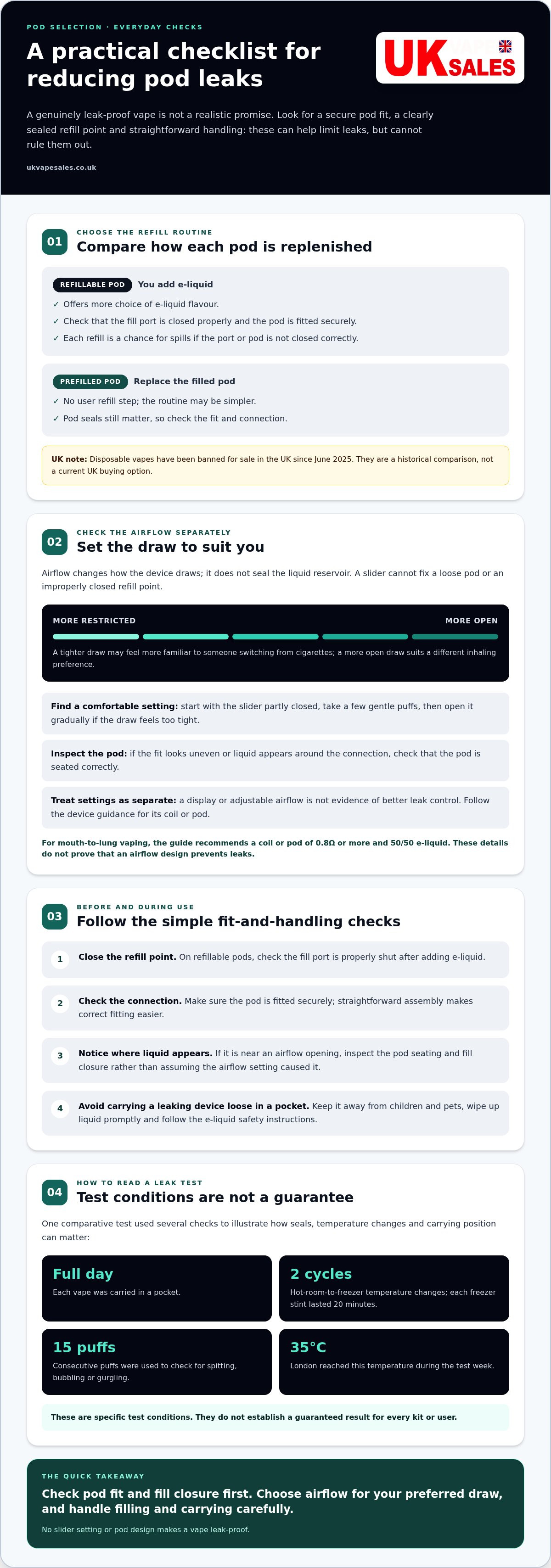
A comparative leak test carried each vape in a pocket for a full day. It also included two hot-room-to-freezer temperature cycles, with each freezer stint lasting twenty minutes, plus fifteen consecutive puffs to check for spitting, bubbling or gurgling. The test took place during a week when London reached 35 degrees. These conditions help illustrate why seals, temperature changes and carrying position can matter, though they don’t establish a guaranteed result for every user.
Refillable and prefilled pod kits both use replaceable pods, but they differ in how you replenish them. Refillable designs require you to add e-liquid; prefilled pods arrive filled. For UK buyers, nicotine-containing e-liquids and tank capacity are subject to restrictions, as is nicotine strength. Choose a compliant kit and compatible liquid, rather than assuming every tank or refill suits every device. [Browse prefilled vape kits] for reusable options with prefilled pods.
For prices, refillable vape kits typically cost between £20 and £26 on the UK market, with a median of about £22. That’s a broad market range, not a price for a particular kit or a measure of leak resistance.
Leaking e-liquid can create a risk of accidental contact or ingestion, especially around children and pets. Keep a leaking device away from them, wipe up liquid promptly and follow the e-liquid’s safety instructions. Don’t carry a visibly leaking vape loose in a pocket.
| Option | Refilling | Leak-related consideration | Best suited to |
|---|---|---|---|
| Refillable pod kit | You add e-liquid | Fill-port closure and pod fit matter | People who want liquid choice |
| Prefilled pod kit | Replace the filled pod | No user refill step, but pod seals still matter | People who prefer a simpler refill routine |
| Disposable vape | Not refillable | Historical comparison only, banned for sale in the UK | Not a current UK buying option |
Choose between refillable and prefilled pods by weighing filling control against convenience. Check pod fit and handling before prioritising battery life or flavour choice.
Airflow designs intended to reduce leaks
Airflow affects how a device draws, but an adjustable slider alone doesn’t make a pod leak-resistant. Assess airflow separately from the seals, pod fit and liquid path, then choose a draw that suits your vaping style.
Airflow is the route air takes through a device as you inhale. A more restricted setting creates a tighter draw, often compared with drawing on a cigarette; a more open setting lets air pass more freely. Neither setting can fix a loose pod or an improperly closed refill point.
Adjustable airflow and vaping styles
Adjustable airflow lets you change the draw without changing the pod. Start with the slider partly closed and take a few gentle puffs. If the draw feels too tight, open it gradually. This helps you find a comfortable setting without assuming maximum airflow is best.
For mouth-to-lung vaping, the guide recommends a higher-resistance coil or pod of 0.8Ω or more. A 50/50 e-liquid is also recommended for MTL devices. These details help match the liquid and coil to the intended draw, but they don’t prove an airflow design prevents leaks.
Airflow and draw styles
A restricted draw may feel more familiar to someone switching from cigarettes, while an open draw suits a different inhaling preference. The airflow opening is part of the route air takes through the device; e-liquid should stay inside the pod or tank. If liquid appears near an airflow opening, inspect the pod seating and fill closure rather than assuming the airflow setting caused it.
Some devices display information such as wattage, while simpler designs rely on physical controls. A display can make settings easier to read, but it is not evidence of better leak control. Before adjusting wattage, follow the guidance for that device’s coil or pod. Changing airflow does not make an incompatible setting suitable.
Compare a device’s adjustable airflow with its pod connection and refill arrangement. A slider makes it convenient to adjust the draw, but a secure, correctly assembled pod is a separate consideration. Don’t assume that an airflow feature proves a model has a leak-resistant design.
- Check the control: confirm whether airflow adjusts on the device or through a fixed opening.
- Set the draw: make small changes and test each setting with gentle puffs.
- Inspect the pod: reseat it if the fit looks uneven or liquid appears around the connection.
Choose airflow for your preferred draw, then assess pod fit and filling separately. No slider setting makes a vape leak-proof.
Airflow designs intended to reduce leaks
Airflow controls the route air takes through a vape, not the seal around its liquid reservoir. An adjustable opening can change the feel of a draw, but it is not a leak-prevention feature by itself.
Check where the airflow enters the device and how it meets the pod. If the air inlet is close to the pod’s liquid chamber, a loose connection or damaged pod may let liquid reach that passage. An airflow control can alter the draw, but it cannot fix a fault in the pod or its fit.
Adjustable airflow and vaping styles
An adjustable control lets you choose between a tighter and a more open draw. The useful setting depends on your preference and the device’s design, not on leak resistance. For a fair comparison, keep the same pod fitted and change only the airflow setting. This helps distinguish a change in draw from a problem caused by replacing or refitting the pod.
Airflow controls also vary in placement. Some can move accidentally as you handle the device; others are less exposed. Before carrying a vape, check whether its control has shifted. If the draw changes unexpectedly, return it to your preferred position and check that the pod is still seated.
Airflow and draw styles
A restricted draw pulls air through a narrower opening; a more open draw uses a wider route. Neither makes a device leak-proof. If liquid repeatedly appears at the mouthpiece or air inlet, inspect the pod and device rather than continuing to adjust the airflow.
Moisture around an opening can have several causes. A small amount near the mouthpiece after use may be residue, but liquid that returns after cleaning needs closer attention. Remove the pod and inspect its exterior and connection point. Don’t push tissue or other objects into narrow air channels: they can damage components or leave fibres behind.
A display or wattage setting is separate from airflow. A screen may show device settings, but it cannot diagnose escaping e-liquid. If the device instructions specify an airflow or power range, follow that guidance instead of changing settings to compensate for persistent leakage.
- Before use: check whether the airflow control has moved during handling.
- If moisture appears: wipe the exterior and inspect the pod connection.
- If it returns: stop adjusting the airflow and assess the pod for damage or poor fit.
Choose an airflow setting for the draw you prefer. Assess the pod and liquid containment separately, as airflow adjustment cannot repair a faulty seal.
Pod vape models described as leak-free
“Leak-free” is a product claim, not a guarantee that e-liquid can never escape. When choosing the best vape that doesn’t leak, compare the pod’s seals, filling method and fit rather than relying on a label.
Start by checking the parts that hold e-liquid: how the pod closes, where it fills and how it connects to the device. Look for clear fitting and filling instructions. A prefilled pod still depends on an intact seal, so “prefilled” does not automatically mean leak-proof.
Models can differ across a product series, even when their outer shape looks similar. Compare the exact device and replacement pod, not just the product-family name. A compact body may be convenient to carry, but its size says nothing about the pod seal or leak resistance.
A screen can show device information, but not whether e-liquid is escaping. A mouthpiece cover or product-series name is not proof of leak protection either. Focus on the liquid path: the fill closure, pod housing and connection point. These are the areas to inspect if you find moisture.
Some models use replaceable pods, while others let you refill them. Neither approach guarantees dry use. Replaceable pods remove the need to refill, but still require an undamaged seal and secure fit. Refillable designs give you more control over e-liquid choice, while requiring careful filling and closure.
After filling a refillable pod, wait at least a minute before vaping so the coil can soak. Keep the pod upright during this pause, wipe away spills, then check that the fill closure is fully shut. If e-liquid appears around the mouthpiece or airflow opening, stop and inspect the pod before vaping again.
- Check compatibility: match the replacement pod to the exact device model.
- Inspect the seal: look for damage, gaps or liquid around the connection.
- Read claims carefully: distinguish leak-resistant wording from an absolute promise.
There is no single best vape that doesn’t leak in every situation. For a reusable pod model, prioritise clear filling instructions, a secure fit and replacement parts designed for that device. These practical details matter more than a screen, compact shape or “leak-free” wording alone.
A kit with a securely fitting pod, clear filling instructions and replacement pods made for the exact device is a sensible option. Neither refillable nor replaceable-pod designs guarantee leak-free use, so check the seals and closure.
UK Vape Sales: Lost Mary BM6000 Refill Pods
UK Vape Sales offers Lost Mary BM6000 Refill Pods for people who already use the BM6000 system and need replacement pods. The BM6000 has a replaceable 2ml pod and a 10ml refill container, so make sure you understand which component needs replacing before choosing parts.
Refill pods aren’t a guarantee against leaks. Use the correct pod for your device, check that it sits securely, and follow the filling instructions. UK Vape Sales also offers Lost Mary BM6000 Kits, IVG Pro 12 Refill Pods and IVG Smart Max Refill Pods. These are different systems, so don’t assume pods are interchangeable.
To browse compatible replacement options, visit UK Vape Sales and view Lost Mary BM6000 Refill Pods.
Choose a kit that fits your routine
Narrow your choice by deciding how you prefer to replenish your vape, how often you carry it and how much upkeep suits your routine. The best vape that doesn’t leak is one whose format and care requirements you can manage comfortably, not simply the one with the strongest claim.
Before choosing, consider where you’ll keep the device and whether you want to handle e-liquid or replace pods. These everyday preferences can make one kit more practical for you than another. Keep the exact device model in mind when choosing compatible parts.
If you’d like help comparing suitable options, get help choosing a suitable kit. Take your time and choose a setup that feels straightforward to use and maintain.
Frequently Asked Questions
What is the most leak-proof vape in 2026?
This guide does not identify a single most leak-resistant model. For a useful comparison, look for repeatable testing that explains how devices were assessed and whether each was tested under the same conditions. Separate evidence about leakage from unrelated features such as battery size, screen design or flavour options. This makes product claims easier to judge without treating “leak-proof” as an absolute promise.
Why Do Vapes Leak in the First Place?
Sometimes moisture around a mouthpiece is condensation rather than a leak from the reservoir. Wipe the area clean, then check whether moisture returns when you haven’t been vaping. Note where it appears: liquid inside the mouthpiece differs from liquid collecting beneath the pod. Recording when moisture shows up, such as after storage or a refill, can help you tell whether the issue is persistent or linked to a particular use pattern.
My Pod Vape Is Leaking – Now What?
First, note where the e-liquid is collecting and whether the pod is refillable or prefilled. Keep the device upright on a tissue while inspecting it, so fresh moisture is easier to spot. Don’t continue using a pod with visible cracks or liquid entering the device body. If a replacement pod also leaks in the same device, compare its condition and fit with the instructions for that specific kit.
What are the best leak-resistant pod vapes available in the UK in 2026?
There’s no verified model-by-model leak ranking here, so choose by the way you want to maintain the device. A kit using prefilled replacement pods avoids handling a bottle; a refillable setup gives you control over the e-liquid. UK Vape Sales offers Lost Mary BM6000 Kits and IVG Kits, but those systems use their own compatible parts and shouldn’t be treated as interchangeable.
What design features prevent vape tanks and pods from leaking?
Assess how the device separates its airflow route from the liquid reservoir, and whether the filling instructions make the closure clear. A visible fill level can help you avoid filling beyond the marked limit. Treat these as useful design checks, not proof of guaranteed performance. Product descriptions should explain specific features rather than rely only on broad “leak-free” wording.
Which replacement pods or coils are least prone to leaking?
There’s no substantiated ranking of replacement pods or coils by leak resistance. Choose the replacement part specified for your exact kit, then check whether that device uses a complete replacement pod or a separately replaceable coil. These formats require different maintenance. For example, the Lost Mary BM6000 system uses its own refill pods; a coil intended for another model won’t become suitable just because its shape appears similar.