

Most vapers assume a burnt taste means they've bought a "dud" coil, but hardware failure is rarely the actual culprit. It's far more likely that a mismatch between your e-liquid viscosity and your wattage settings is scorching the cotton before it has a chance to soak. There's nothing more frustrating than wasting a fresh pod or ruining a premium bottle of nic salt because of a single dry hit. We know how annoying it is to watch your money go up in smoke, especially when you're looking for a consistent, clean experience from your refillable kit.
If you want to learn how to stop your vape coil from burning, this professional guide provides the exact routine used by specialists to maintain peak performance. You'll discover why certain "coil killer" ingredients in sweet e-liquids are ruining your hardware and how a simple change in your priming habits can significantly extend the life of your coils. We'll provide a clear, actionable plan to ensure every puff delivers the pure flavour you expect without the nasty burnt aftertaste.
Key Takeaways
- Master a professional 5-step priming routine to ensure your cotton is fully saturated before you take your first puff.
- Learn how to stop vape coil from burning by matching your e-liquid's VG/PG ratio to your specific device and coil resistance.
- Identify "coil killer" ingredients and why premium nic salts are better for pod system longevity.
- Understand the importance of "wick recovery time" to prevent the scorched cotton caused by aggressive chain-vaping.
- Discover specific maintenance tips for high-capacity refillable pod kits to keep the internal refill system flowing correctly.
Understanding the "Burnt Hit": Why Your Coil Fails
A burnt hit is the single most unpleasant experience in vaping. It's often misunderstood as a hardware defect, but usually, it's a failure of physics. To understand how to stop vape coil from burning, you first need to distinguish between a dry hit and a truly burnt coil. A dry hit happens when the wick is slightly under-saturated; it tastes "thin" or slightly hot. A burnt coil, however, means the actual cotton fibres have been scorched. Once those fibres are charred, that acrid taste is permanent and cannot be "washed out."
Inside your tank or pod, capillary action is the force that pulls e-liquid from the reservoir into the centre of the wick. When you heat the coil, the liquid turns to vapour, and the space in the wick should immediately be refilled. If the liquid is too thick or the wick is too tight, this flow stops. The heating element then begins to cook the dry cotton instead of the liquid. Understanding the components of an e-cigarette helps you realise that the coil and wick are a delicate ecosystem. Modern mesh coils use a metal grid rather than a single wire. This creates a larger surface area for heating, which delivers better flavour but also means the cotton can scorch much faster if juice flow is interrupted.
The Science of the Wick and Wire
When juice flow is restricted, the cotton fibres become singed. This creates a layer of carbon on the surface of the heating element. This process is accelerated by "caramelisation." Many popular nic salts contain high levels of sweeteners that don't vapourise cleanly. Instead, they turn into a dark, sticky residue often called "coil gunk." This gunk traps heat, prevents new juice from reaching the wire, and eventually causes the cotton underneath to burn. This is why a single burnt hit often ruins the entire coil for good.
Signs Your Coil is About to Burn
Catching the problem early can save your hardware. You'll notice a slight loss in flavour clarity before the burnt taste arrives. Your favourite fruit juice might suddenly taste muted or "flat." Another warning is an acrid scent in the vapour, often described as a faint "bacon" smell. If you use a transparent pod, look for dark patches on the visible cotton. These are scorched spots where the liquid is no longer flowing correctly. Learning how to stop vape coil from burning starts with recognising these early indicators before you take a full, scorched draw.
How to Prime Your Coil Properly: A 5-Step Process
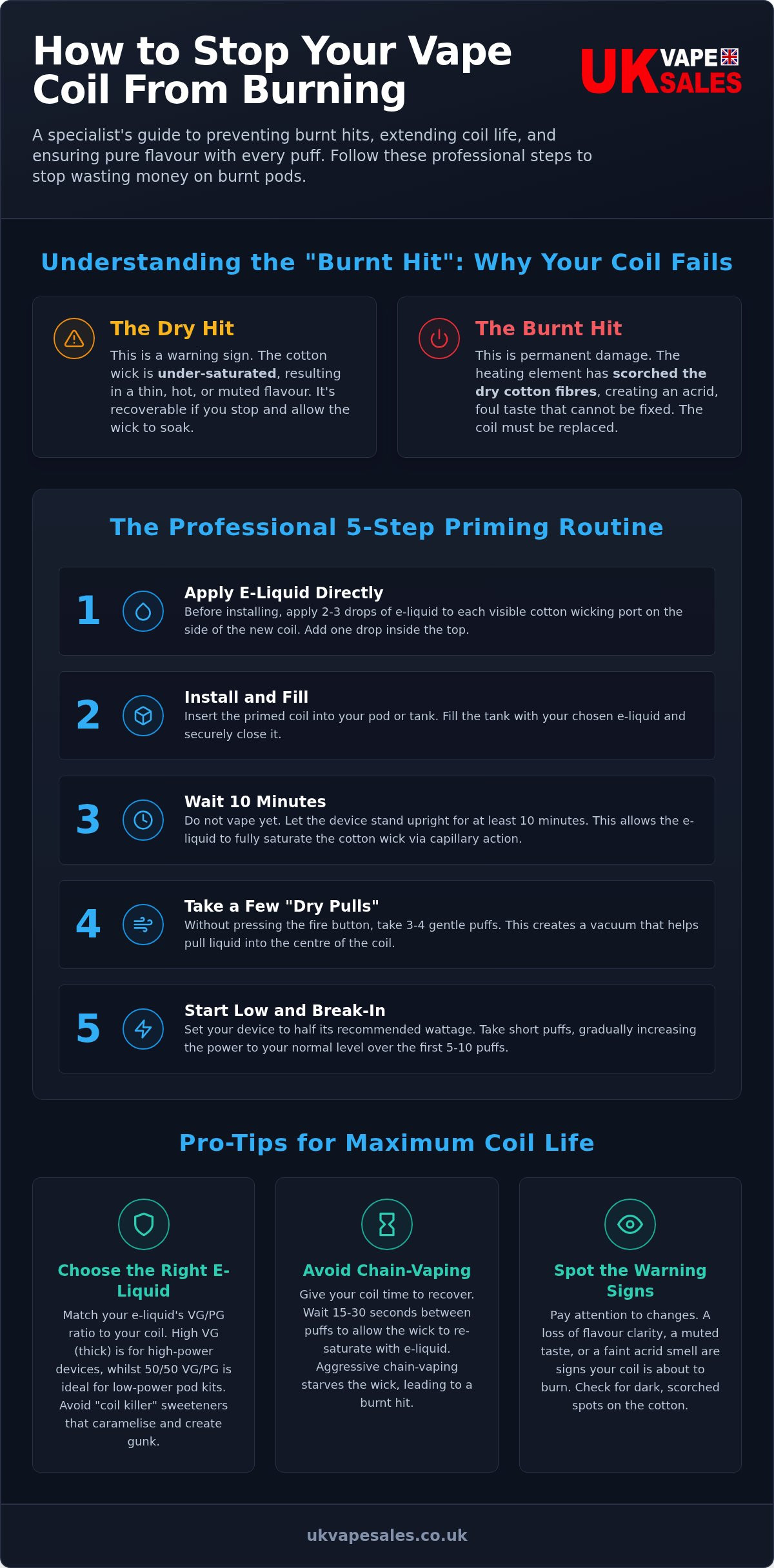
Priming is the process of pre-saturating the wick to prevent air pockets. This foundational step is the most effective way to learn how to stop vape coil from burning before you've even taken your first puff. If you fire a new coil without this preparation, the dry cotton can char instantly, ruining the flavour for the life of the pod. By taking five minutes to prepare your hardware, you ensure the heating element is always in contact with liquid rather than dry fibres.
The Pre-Installation Drop Method
The first step involves applying e-liquid directly to the coil before it enters the device. Locate the wicking ports, which are the small holes where the white cotton is visible. Apply two or three drops to each port and a single drop inside the top of the coil, being careful not to flood the centre. Over-saturation here can lead to gurgling or leaking later on. Understanding the composition of e-liquids is vital; certain additives and high VG ratios make the liquid more viscous, requiring more time to fully penetrate the dense cotton fibres used in modern mesh coils.
The Ten-Minute Rule
Once the coil is installed and the tank is filled, the third step is waiting. Whilst five minutes might suffice for some, ten minutes is the gold standard to ensure every air pocket has been displaced by juice. You can accelerate this with the fourth step: "dry pulls." Take three or four puffs on the device without pressing the fire button. This creates a vacuum that pulls e-liquid deep into the wick, ensuring the centre of the coil is just as wet as the outside.
Finally, the fifth step is the break-in period. Instead of jumping straight to your usual power setting, start at roughly half your target wattage. Use the pulse technique by firing the device in short, half-second bursts. This warms the liquid, making it thinner and easier for the cotton to absorb. Gradually increase the power every few puffs until you reach your preferred setting. If your current coil already tastes like burnt toast, it's best to start over with fresh replacement refill pods and follow this professional routine from the start.
Choosing the Right E-Liquid: VG/PG Ratios and Sweeteners
Choosing the wrong juice is the most common reason people struggle with how to stop vape coil from burning. It isn't just about the flavour; it's about the physical thickness of the liquid. Vegetable Glycerin (VG) is the ingredient responsible for thick vapour clouds, but it's also very viscous. If your e-liquid is too thick for your specific coil, the cotton cannot absorb it fast enough between puffs. This leads to dry spots and eventually causes potential hardware problems like overheating and scorched wicks. Matching your coil resistance to juice viscosity is a professional secret. Higher resistance coils, typically those above 1.0 ohm, have very narrow juice channels. If you force a thick 70% VG liquid through a 1.2 ohm coil, you're essentially starving the heating element.
The 50/50 vs High VG Debate
Most UK pod vapers should stick to a 50/50 ratio. Whilst sub-ohm coils are large enough to handle 70% VG, the tiny wicking ports in refillable pods will struggle. Using a high VG liquid in a small pod results in instant dry hits because the juice moves too slowly to replenish the wick. Transitioning to nic salts is often the best solution for those using compact kits. These liquids are specifically balanced for pod systems, ensuring the cotton stays saturated even during frequent use. If you notice your pod is struggling to keep up, check the label; if it says 70% VG or "High VG," that is likely your culprit.
Identifying Coil-Friendly Brands
Sweeteners are the primary "coil killers" in the vaping world. Brands like Bar Juice 5000 are engineered to mimic disposable flavours whilst remaining kind to your hardware. In contrast, many dessert-flavoured juices use heavy sucralose which carbonises on the wire. You should also consider the colour of your juice. Clear e-liquids generally outlast darker ones because they contain fewer solids that can gunk up the mesh. Choosing TPD-compliant brands like Elfliq or Elux ensures you're getting a consistent, high-quality product that won't ruin your coil in a single afternoon. These brands prioritise cleaner-burning ingredients that preserve the integrity of your cotton for much longer than generic, high-sugar alternatives.
Vaping Technique: Stopping Chain-Vaping Damage
Even with a perfectly primed coil and the correct e-liquid, your physical vaping style can still be the weak link. Many new vapers struggle with how to stop vape coil from burning because they carry over habits from smoking traditional cigarettes. Short, sharp, and frequent drags don't give the hardware enough time to reset. Unlike a cigarette that burns at a constant rate, a vape coil relies on a delicate balance of temperature and fluid dynamics. If you take aggressive puffs in quick succession, you are essentially asking the wick to perform the impossible. By the third or fourth draw, the cotton in the centre of the coil is likely bone dry, even if your tank is full.
Maintaining your tank level is another simple but vital technical habit. You should ensure your reservoir is never less than a third full. Most modern pods have juice intake ports located halfway up the coil housing. If your liquid level falls below these ports, the vacuum seal is broken and air enters the wick instead of juice. Keeping your reservoir topped up ensures there is always enough hydrostatic pressure to force the e-liquid into the cotton fibres, preventing the "dry spots" that lead to permanent charring.
The 15-Second Rule
Wick recovery time is the window your coil needs to pull in fresh juice after a draw. Waiting 15 to 30 seconds between puffs is the most effective way to maintain saturation and protect your hardware. Chain vaping causes the coil temperature to exceed the juice flow rate. When heat builds up in the pod housing during long sessions, the liquid becomes too thin and the cotton can no longer hold it effectively, leading to both leaking and scorching. If you find yourself constantly reaching for your device, consider switching to a higher-strength nic salt to satisfy your cravings with fewer draws.
Wattage and Airflow Management
Always check the side of your coil for the laser-etched "recommended wattage" range. Exceeding this limit, even by a few watts, will burn the cotton almost instantly. Similarly, if you've restricted your airflow for a tighter draw, remember that less air means less cooling for the heating element. This extra heat has nowhere to go but into the wick. Finally, always lock your device before putting it in your pocket or bag. A "pocket fire" for even five seconds is enough to ruin a fresh pod. If you're looking for a device with intelligent power management to help prevent these issues, explore our range of vape hardware designed for durability and consistent performance.
Maintaining High-Capacity Systems: BM6000 and IVG Pro 12
High-capacity TPD-compliant kits represent a significant shift in the UK market, offering a cost-effective bridge between traditional disposables and fully refillable systems. However, these devices have unique wicking requirements that differ from standard pods. If you're using the Lost Mary BM6000, understanding the relationship between the 10ml refill container and the internal 2ml pod is vital. The coil sits inside that smaller pod; if it runs dry because the larger reservoir hasn't replenished it, the cotton will scorch instantly. Learning how to stop vape coil from burning in these systems often comes down to gravity and pressure management.
Refilling Large-Format Pods
To ensure your BM6000 stays saturated, you must occasionally tilt the device upside down. This motion allows the e-liquid to flow from the 10ml bottle into the vaping chamber. Air bubbles in the container can block this flow, so ensure the bottle is clicked in securely to maintain the necessary vacuum pressure. Similarly, the IVG Pro 12 relies on specific pod rotation to keep the wick wet. If you experience "no-flavour" hits, it's a sign that the juice isn't reaching the coil fast enough. Switching to dedicated refillable pods offers more control over this process, as you can manually monitor the levels and avoid the air-lock issues common in some high-capacity designs.
When to Admit Defeat and Replace
Many vapers attempt to wash or clean a scorched coil to save money, but this is a false economy. Once the cotton fibres are carbonised, the structure is permanently damaged. A compromised wick doesn't just taste bad; it loses its ability to hold liquid, which often leads to leaking. This juice can seep into the device and corrode the battery contacts, potentially ruining your entire kit. If you've followed the priming and technique advice in this guide but still face inconsistency, it might be time to choose hardware known for its reliability. Systems like the SKE Bar Original are highly regarded for their consistent wicking and robust coil life. Mastering how to stop vape coil from burning eventually leads to a more satisfying and cheaper vaping journey, ensuring every puff is as fresh as the first.
Master Your Hardware for Better Flavour
Mastering the 10-minute priming rule and selecting e-liquids with fewer sweeteners are the most effective ways to preserve your pods. Remember that your technique is just as vital as the juice you use; allowing your wick to recover between puffs prevents the heat build-up that destroys cotton fibres. When you understand how to stop vape coil from burning, you'll save money on replacements and enjoy a much cleaner experience every day.
Ready to upgrade your setup? Shop our range of coil-friendly Nic Salts and Refillable Kits at UK Vape Sales. We provide 100% authentic TPD-compliant products and specialist advice from seasoned vapers. You can also benefit from free UK shipping on qualifying orders to get your supplies delivered quickly. With the right routine, you'll finally say goodbye to nasty burnt hits and keep your favourite flavours tasting exactly as they should.
Frequently Asked Questions
How long should a vape coil usually last?
A standard vape coil usually lasts between one and two weeks. This lifespan varies based on how frequently you vape and the type of e-liquid you use. Heavy sweeteners and high VG ratios shorten this window, whilst clear, simple flavours like menthol tend to preserve the cotton for longer. If you notice a drop in flavour clarity or vapour production, it is time for a replacement.
Can I clean a burnt coil to make it taste better?
You cannot effectively clean a burnt coil once the cotton fibres have been scorched. Whilst some vapers suggest soaking them in warm water or alcohol, this rarely removes the carbonised residue trapped deep in the wick. It often results in a muted, unpleasant taste and can even cause the coil to leak. Replacing the pod or coil is the only way to restore the original flavour profile.
Why does my new coil taste burnt immediately after priming?
This usually happens because air pockets are still trapped inside the dense cotton fibres. Even if you have followed a priming routine, the centre of the wick might still be dry. Ensure you wait the full ten minutes and take a few dry pulls without power to create a vacuum. Starting at a wattage higher than the coil's minimum rating can also instantly singe the cotton.
Does a higher nicotine strength make coils burn out faster?
Nicotine strength itself does not typically cause coils to burn out faster. However, the type of nicotine matters; freebase nicotine can be harsher at high temperatures compared to nic salts. The real impact comes from your usage patterns. If a low nicotine strength leads you to chain-vape to satisfy cravings, the constant heat will degrade the wick much quicker than occasional, high-strength puffs.
What is the best wattage to stop my coils from burning?
The best wattage is always within the recommended range laser-etched onto the side of your coil. To learn how to stop vape coil from burning, you should start at the lowest end of this suggested range. Gradually increasing the power allows the wick to adjust to the heat. Exceeding the maximum recommended wattage will scorch the cotton almost immediately, regardless of how well you have primed it.
Is it normal for my e-liquid to turn dark in the pod?
It is quite common for e-liquid to darken over time due to oxidation and heat. As the coil heats the juice, some residue from the sweeteners can leach back into the reservoir, turning the remaining liquid a brown or amber hue. If the liquid turns very dark and the flavour becomes bitter, it is a sign that "coil gunk" has built up and a replacement is needed.
How much e-liquid should I leave in the tank to avoid burning?
You should always keep your tank or pod at least one-third full. Most coils have juice intake ports located partway up the metal housing. If the liquid level falls below these ports, the wick cannot pull in enough juice to stay saturated. This leads to dry spots and permanent burning. Keeping the level topped up ensures constant pressure and a steady flow of liquid to the heating element.
Why do sweet flavours burn coils faster than menthol?
Sweet flavours contain high levels of sucralose that do not vapourise completely. Instead of turning into vapour, these sugars caramelise on the hot coil, creating a black, crusty residue. This gunk prevents new juice from reaching the wire. Menthol and mint liquids generally contain fewer solids, allowing them to vapourise cleanly and keep the cotton functional for much longer. Knowing how to stop vape coil from burning often involves choosing these cleaner-burning liquids.