

What if the calories listed for e-liquid don’t tell you how many your body takes in? If you’re wondering how many calories are in a vape, there isn’t a reliable figure for calories absorbed from vaping. E-liquid ingredients may have an energy value when eaten, but inhaling an aerosol is not the same as consuming food. The two should not be treated as equivalent.
It’s understandable to wonder whether vaping could affect your weight, especially when flavours taste sweet. This guide separates what e-liquid contains from what can be said about inhaling it. It also explains why nicotine and appetite are separate questions from calorie claims, without making unsupported claims about vaping’s effects.
You’ll learn what the available evidence can and can’t tell you, how to assess claims about e-liquid ingredients, and where to seek reliable health advice if nicotine or weight is on your mind.
Key Takeaways
- For how many calories are in a vape, distinguish figures for e-liquid from claims about what someone absorbs.
- Consider what happens as e-liquid is heated, turned into aerosol and inhaled. These are separate stages, not interchangeable calorie measures.
- When thinking about weight or appetite, separate questions about nicotine from calorie claims rather than assuming one explains the other.
- Check the source, measurement method and limitations behind calorie-per-puff or per-bottle figures.
How many calories are in a vape? The short answer
There’s no reliable standard figure for how many calories are in a vape or a puff. A calorie measures energy, but an energy value calculated for an e-liquid ingredient doesn’t tell you how much energy a person absorbs by inhaling aerosol. Food is eaten and digested; vaping is a different route of exposure, so food-label values can’t simply be applied to it.
That distinction matters if you’ve seen confident claims about calories per puff or per bottle. A number based on the energy of liquid ingredients is not a measurement of calories consumed by someone vaping. Without reliable evidence measuring absorption, it’s not accurate to call vaping calorie-free or to give a precise intake figure.
Why is there no simple calorie count for a vape?
Vaping doesn’t involve one fixed amount of liquid or one identical puff. Devices, e-liquids and puffing patterns vary, as can the resulting exposure. A single number therefore won’t reliably describe every person’s use. A laboratory value for the energy in a substance also answers a different question from how much, if any, a person absorbs through inhalation.
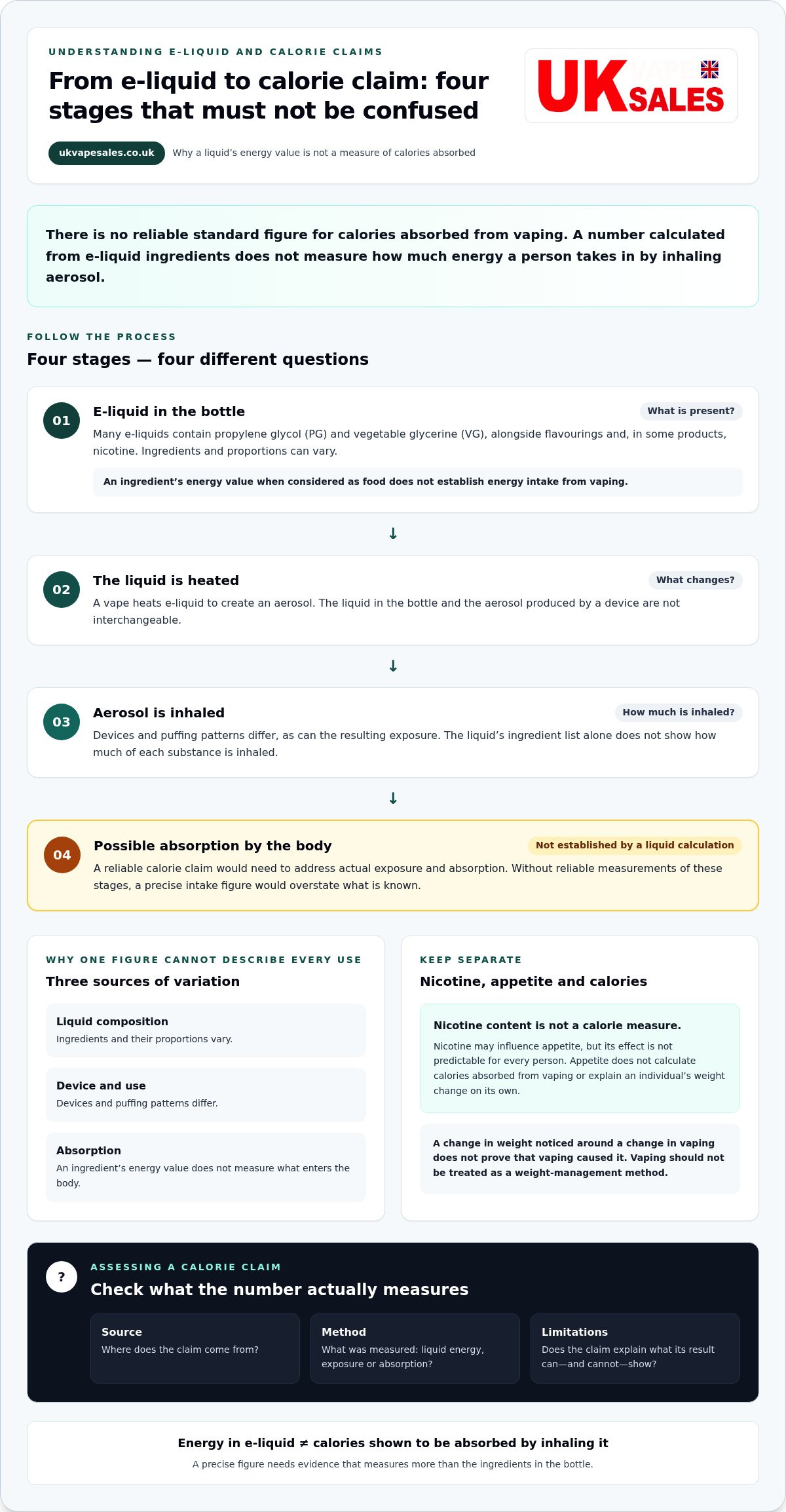
Energy in e-liquid is not the same as calories actually consumed by inhaling it.
- Liquid composition: Ingredients and their proportions vary.
- Use: Devices and puffing patterns differ.
- Absorption: An ingredient’s energy value doesn’t measure what enters the body.
Does vape juice contain calories?
Many e-liquids use propylene glycol (PG) and vegetable glycerine (VG) as base ingredients, alongside flavourings and, in some products, nicotine. An overview of electronic cigarettes describes common components and how these products work, but it doesn’t establish a calorie count for an individual’s vaping.
Even if an ingredient has an energy value when considered as food, that alone can’t show how much energy inhalation provides. A reliable claim about a bottle, puff or vaping session would need to address actual exposure and absorption, not just calculate energy from the liquid’s ingredients. Treat precise figures cautiously if they don’t explain what was measured and what the result represents.
What happens to e-liquid ingredients when you inhale vape aerosol?
A vape heats e-liquid to create an aerosol that’s inhaled. The liquid in a bottle, the aerosol produced by a device and the substances a person may absorb are not interchangeable. Knowing what’s in the liquid helps explain its composition, but it doesn’t tell you how much of each substance is inhaled or absorbed.
This distinction matters when considering how many calories are in a vape. A calculation based on ingredients in liquid does not measure a person’s energy intake from vaping. To establish that, evidence would need to examine what happens during use and what the body absorbs. Without reliable measurements of those stages, a precise calorie total would overstate what’s known.
What are propylene glycol and vegetable glycerine?
Propylene glycol (PG) and vegetable glycerine (VG) are common base ingredients in e-liquids. They are part of the liquid before use; heating then produces an aerosol with a different composition. The proportions and other ingredients can vary between liquids. For example, e-liquid shortfills are one liquid format, but the format alone doesn’t establish what a person absorbs.
An ingredient’s properties in a bottle can’t tell you how much reaches the body after heating and inhalation. These are separate questions: what is present in the liquid, what is carried in the aerosol, and what is absorbed. A value for the first stage shouldn’t be presented as a measured result for the last.
Does nicotine change the calorie count?
Nicotine content isn’t a dependable measure of calories in a vape. It describes nicotine in the liquid, not the energy content of a person’s inhaled dose. Nicotine-containing e-liquids come in different formats, including nicotine salts, but the format or stated nicotine content doesn’t provide a calorie figure.
Keep these questions separate. Nicotine’s possible relationship with appetite is different from the calorie content of e-liquid, and neither should be used to infer the other. The key point is that e-liquid is heated into aerosol, but liquid ingredients alone can’t establish how much is inhaled or absorbed. That uncertainty is why calorie calculations need clear supporting measurements and stated limitations.
Can vaping affect your weight or appetite?
Calorie content alone can’t explain a change in body weight, and an uncertain calorie figure for vaping shouldn’t be used to account for weight gain or loss. Appetite, eating habits, activity, stress, health and changes in nicotine use may all be relevant. A change noticed around the same time as a change in vaping doesn’t prove that vaping caused it.
This helps put how many calories are in a vape into perspective: calorie claims and questions about nicotine’s possible effects are separate issues. Vaping shouldn’t be treated as a weight-management method, and nicotine shouldn’t be started or used to control appetite.
Does nicotine affect appetite or body weight?
Nicotine may influence appetite, but its effect isn’t predictable for every person and it doesn’t determine someone’s weight. Appetite is only one part of eating and weight, so it can’t be used to calculate calories taken in from vaping or explain an individual’s weight change on its own.
An appetite effect is not the same as calorie intake. Nicotine content in an e-liquid doesn’t show how much someone eats, how their weight will change or how many calories they absorb through vaping. Avoid drawing conclusions about weight from nicotine strength or flavour alone.
What if you are worried about weight after changing your nicotine use?
If your weight or appetite changes after you alter your nicotine use, the timing alone can’t identify the cause. Other changes in routine, diet, activity or health may also matter. Don’t respond by increasing nicotine use or changing how you vape to try to manage your weight.
If a change persists, feels worrying or comes with other symptoms, speak with a GP or another qualified health professional. They can consider your circumstances and advise on suitable next steps. If you’re thinking about stopping vaping, make that decision for your own health reasons rather than as a weight-loss measure. A health professional can help you discuss concerns that come up during the process.
How should you think about calories in a vape?
Use caution with online figures for calories per puff or per bottle. A confident number isn’t necessarily a measured calorie intake. To judge a claim about how many calories are in a vape, check what the number describes and what evidence supports it.
Use this checklist:
- What was measured? Is the claim about energy in the liquid, substances in the aerosol or absorption by a person? These are different measures.
- How was it measured? Look for a named method, not just a calculation based on ingredients.
- Who or what was studied? Check whether the evidence concerns a laboratory sample or people using a vape, and whether the results support the claim being made.
- Are limitations explained? Reliable information should say what it can’t establish, rather than turning an estimate into a precise personal figure.
- Is the source suitable and current? Give priority to reputable scientific or health sources, and check when the information was published or updated.
If a calorie-per-puff or per-bottle figure gives no source or method, don’t treat it as a reliable measure of what your body takes in. A calculation based only on e-liquid ingredients can’t establish personal calorie intake.
Should vaping be entered in a food calorie tracker?
Ordinary food calorie tracking is designed to record food and drink, not aerosol inhaled from a vape. Don’t log vaping as though you’ve eaten a serving of e-liquid. That would treat two different kinds of exposure as equivalent and could give a misleading impression of your food intake.
The practical takeaway is straightforward: don’t infer a personal calorie total from the ingredients in a vape liquid. The claim needs to match the evidence behind it, and its limits should be clear.
When should you seek individual advice?
If you have persistent or worrying weight changes, appetite concerns or other health questions, speak with your GP or another qualified health professional. They can consider your circumstances. This article can’t diagnose the cause or provide personalised nutrition or nicotine advice, and a calorie claim about vaping shouldn’t replace individual guidance.
Make your next step an informed one
A calorie figure can look reassuringly precise, but precision isn’t the same as dependable evidence. If you’re still wondering how many calories are in a vape, don’t let an unsourced number guide decisions about your diet, weight or nicotine use. For personal concerns, a qualified health professional is better placed to discuss your circumstances.
For general vaping information and to compare e-liquid and kit formats, explore UK Vape Sales. Product details can help you understand what is available and what ingredients are listed, but they aren’t a substitute for nutrition information or individual health advice.
Check where calorie claims come from, be wary of figures without a method, and seek help if a health concern persists. You don’t need to make decisions based on guesswork. With reliable information, you can choose a sensible next step.
Frequently Asked Questions
Does vaping have calories?
The phrase “calories in a vape” can refer to different things, so check what a figure describes before using it. A number attached to a liquid sample doesn’t automatically describe a device, a session or a person. When comparing online claims, check the unit and what is being measured, such as a quantity of liquid rather than a person’s daily intake.
Can your body absorb calories from vape aerosol?
A calorie figure for energy absorbed by a person would need evidence about human exposure, not just a calculation based on ingredients. If a source doesn’t explain how it measured absorption, don’t treat its number as a personal estimate. When two websites give different figures, compare what each actually measured before deciding whether they’re discussing the same thing.
Does vape juice contain calories if you swallow it?
Swallowing e-liquid is not the same as vaping, and a calorie estimate can’t tell you whether an accidental swallow is harmful or what to do next. E-liquid isn’t a food or drink. If someone has swallowed some, contact a qualified healthcare professional for advice based on the product and circumstances. Don’t use a calorie figure to assess the situation.
Can vaping make you gain weight?
A change in weight has more than one possible explanation, so a vape-related calorie estimate can’t identify the cause. If you’re concerned, note what has changed and when, then discuss the pattern with a qualified health professional. This keeps the conversation focused on your circumstances rather than an online figure that may not describe personal intake.
Does nicotine affect appetite or metabolism?
There isn’t a single predictable effect that can be assumed for every person. If you notice a change in appetite alongside a change in nicotine use, that timing can be useful context for a health professional, but it doesn’t prove cause and effect. Don’t use nicotine or alter its use to manage appetite or try to change your metabolism.
Should I count vaping in my daily calorie intake?
Keep a food diary focused on foods and drinks rather than recording vaping as a meal or snack. If a dietitian or healthcare professional has asked you to track intake for a particular reason, follow their instructions about what to include. An unverified vape-calorie estimate won’t make your food record more accurate, and it shouldn’t be used to adjust meals.