

Why does the same bottle of nic salt taste incredible in one pod but harsh and thin in another? If you've ever struggled with pods burning out too quickly or vapour that feels uncomfortably hot, the answer usually lies in a single small number printed on your refill. Deciding between 0.6Ω vs 0.8Ω vs 1.0Ω Vape Pods: Which Should You Choose? is about more than just cloud size. It's the most important factor in how your device performs from your first morning puff until you head to bed.
It's frustrating when a pod leaks or your battery drains by lunchtime because the resistance isn't matched to your vaping style. We'll show you exactly how pod resistance transforms your experience, from flavour depth to your weekly running costs. This guide breaks down the specific strengths of each ohm level, helping you find the perfect balance for your favourite liquids and ensuring your hardware lasts as long as possible.
Key Takeaways
- Understand how resistance dictates your vapour production, with lower ohms offering a warmer, more intense draw and higher ohms focusing on battery efficiency.
- Navigate the choice of 0.6Ω vs 0.8Ω vs 1.0Ω Vape Pods: Which Should You Choose? by aligning your hardware with your preferred throat hit and nicotine strength.
- Learn to match your e-liquid’s VG/PG ratio to your pod’s resistance to prevent common issues like leaking or premature coil burnout.
- Discover the simple 3-step framework for selecting the right pod for your kit, ensuring you get the most flavour from every refill.
- Identify the clear signs of pod degradation so you can replace your hardware before the flavour drops off or a burnt taste occurs.
Understanding Vape Pod Resistance: What Do the Ohms Actually Mean?
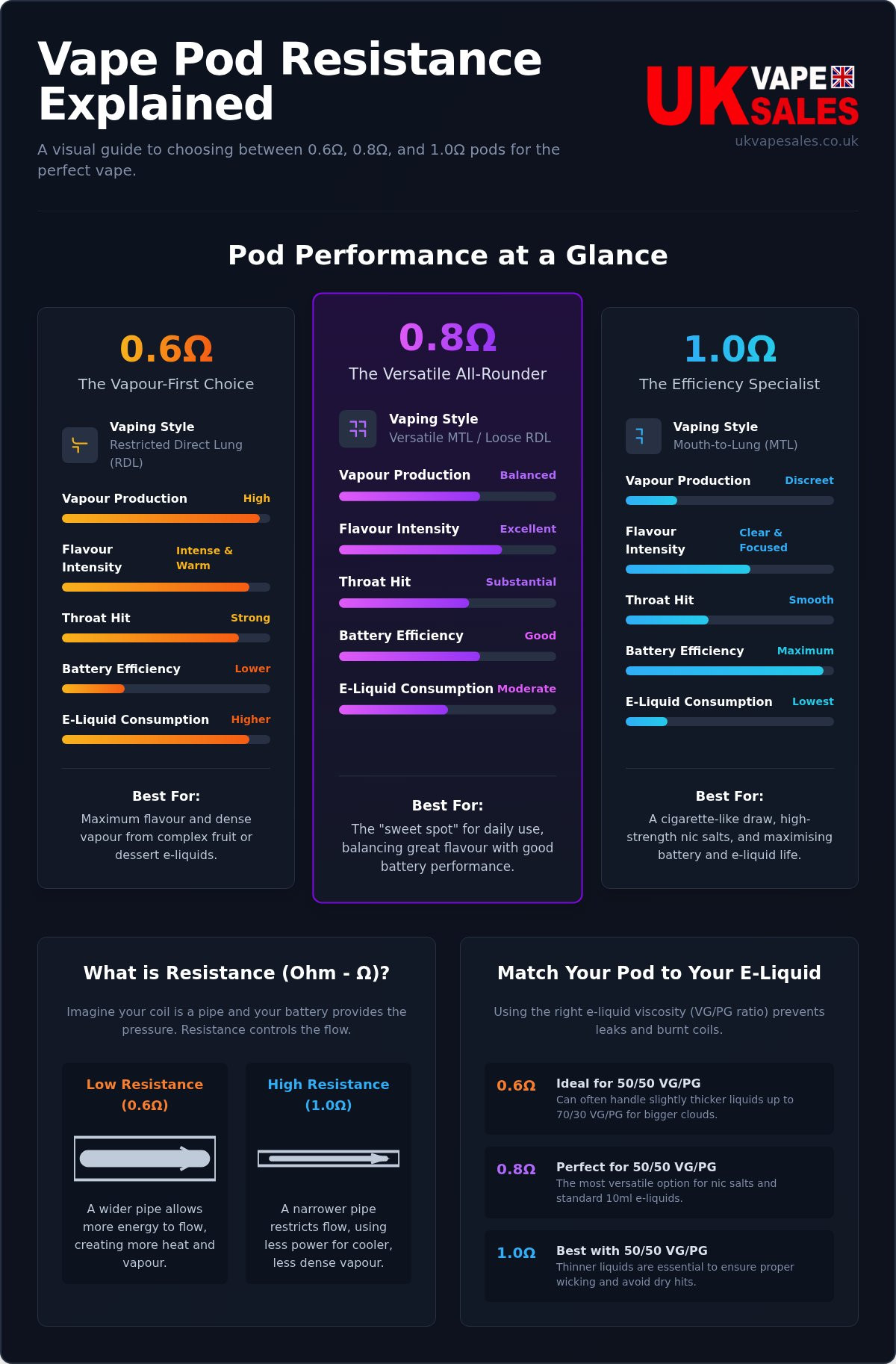
An ohm is the measurement of electrical resistance that controls how much current flows through your coil. To grasp how this affects your daily vape, it helps to imagine a water pipe. In this analogy, the battery provides the water pressure, and the coil is the pipe itself. A high-resistance coil, like a 1.2Ω or 1.0Ω pod, acts as a narrow pipe that restricts the flow. A low-resistance coil, such as a 0.6Ω pod, is a wider pipe that allows more energy to surge through at once.
Historically, early vaping hardware relied on very high resistance coils to manage limited battery power. However, as technology has improved, the industry has shifted towards the 0.6Ω to 1.2Ω range found in most modern kits. This shift allows for better flavour and more consistent performance. Understanding Vape Pod Resistance is the first step in mastering your setup, especially when deciding between 0.6Ω vs 0.8Ω vs 1.0Ω Vape Pods: Which Should You Choose? for your specific device.
The Relationship Between Power, Heat, and Vapour
Lower resistance requires more power from your battery, which in turn generates significantly more heat. This is why a 0.6Ω pod feels warmer and produces much larger clouds than a 1.0Ω pod. The increased heat also intensifies the "throat hit" of your nicotine. This can make a 20mg nic salt feel much harsher than intended if you aren't using the correct hardware for your tolerance.
Heat also plays a vital role in how you perceive flavour. Complex e-liquids with multiple dessert or tobacco notes often reveal different nuances at higher temperatures. Conversely, delicate fruit flavours might taste slightly muted or even "overcooked" if the coil gets too hot. Balancing these factors is essential for a satisfying experience that lasts the whole day.
Why Resistance Matters for Modern Pod Users
The resistance of your pod dictates the physical "draw" of the device. A 1.0Ω pod usually offers a tight, restricted draw known as Mouth-to-Lung (MTL), mimicking the feel of a traditional cigarette. A 0.6Ω pod typically provides a looser, Restricted Direct Lung (RDL) draw. If you use a pod that doesn't match your inhaling style, you might experience performance issues.
- Gurgling: Using a high-resistance pod with very thin e-liquid can cause the coil to flood.
- Leaking: Excessive heat in a low-resistance pod can thin out the liquid too much, leading to leaks in the base.
- Dry Hits: Using thick liquid in a 1.0Ω pod often prevents the wick from saturating quickly enough, leading to a burnt taste.
Choosing the right refill pods ensures your device operates within its intended parameters, protecting both your battery longevity and your coils.
The 0.6Ω vs 0.8Ω vs 1.0Ω Breakdown: Performance and Draw
Most modern refillable kits, such as the popular Vaporesso XROS series, offer a variety of pod options to suit different preferences. Deciding on 0.6Ω vs 0.8Ω vs 1.0Ω Vape Pods: Which Should You Choose? is no longer just about cloud size. The introduction of mesh coil technology has changed the landscape, allowing even high-resistance pods to deliver exceptional flavour. However, the physical draw and the rate at which you consume e-liquid still vary significantly between these three options.
0.6Ω Pods: The Vapour-First Choice
These pods are designed for Restricted Direct Lung (RDL) vaping. They feature a looser airflow that allows you to pull the vapour directly into your lungs with less resistance. Because the coil has a lower resistance, it draws more power from the battery to create a warmer, denser vapour. This makes them the ideal choice for complex dessert or fruit blends where you want the most intense flavour possible. Be aware that this performance comes at a cost; you'll find yourself refilling the 2ml pod more frequently and charging your device sooner.
0.8Ω Pods: The Versatile All-Rounder
The 0.8Ω pod is often called the "goldilocks" resistance because it sits perfectly in the middle. It provides a balanced throat hit that isn't too aggressive but still feels substantial. It works brilliantly for both traditional Mouth-to-Lung (MTL) vaping and a slightly looser draw. Many UK vapers find this to be the sweet spot for daily use, as it offers a noticeable upgrade in flavour over higher-resistance pods without draining the battery as fast as a 0.6Ω option.
1.0Ω Pods: The Flavour and Battery Specialist
If you prefer a tight, cigarette-like draw, the 1.0Ω pod is your best match. These are built for MTL vaping, producing a discreet amount of vapour that is perfect for public settings. Because they operate at lower wattages, they are incredibly efficient. You'll get the maximum possible life out of your battery and your e-liquid. This resistance is particularly effective with high-strength nic salts, providing a smooth experience that focuses on nicotine delivery rather than cloud production.
When making your choice, consider your long-term running costs. With the new UK Vaping Products Duty starting on October 1, 2026, at a rate of £2.20 per 10ml of e-liquid, choosing a more efficient 1.0Ω pod can lead to significant savings over time. If you're looking to experiment with different styles, picking up a variety of refill pods is the most effective way to find your personal preference.
Matching Your Pod Resistance to Your Favourite E-Liquids
Choosing the right liquid is just as important as the hardware itself. When vapers ask, 0.6Ω vs 0.8Ω vs 1.0Ω Vape Pods: Which Should You Choose?, they often overlook how e-liquid thickness, or viscosity, impacts performance. Most e-liquids use a blend of Vegetable Glycerin (VG) and Propylene Glycol (PG). VG is thick and syrupy, while PG is thin and carries flavour. If you use a thick liquid in a pod with small wicking ports, like a 1.0Ω coil, the cotton won't saturate fast enough. This leads to a dry hit and a ruined pod.
The Best Resistance for Nicotine Salts
For those using nic salts, the 0.8Ω and 1.0Ω pods are the gold standard. Nicotine salts are designed to be smooth even at the maximum UK legal limit of 20mg. However, because 0.6Ω pods operate at higher wattages, they vaporise more liquid per puff. This often makes 20mg salts feel uncomfortably harsh on the throat and can deliver too much nicotine at once for most users.
If you want to replicate the intense, smooth sensation of a modern pod system, the 0.8Ω mesh pod is your best bet. It provides enough heat to make the flavour profile stand out without the aggressive throat hit of a lower resistance. This works exceptionally well with high-flavour liquids; you can find recommendations in our guide to the Best Bar Juice 5000 Flavours UK.
Freebase E-liquids and Higher VG Blends
Freebase nicotine e-liquids often come in 50/50 or 60/40 ratios. These are slightly thicker than some salts and pair perfectly with 0.6Ω pods. The larger wicking holes in a 0.6Ω pod can keep up with the thicker consistency, ensuring the cotton stays saturated even during frequent use. If you prefer a 6mg or 12mg freebase liquid, the 0.6Ω pod will provide the necessary warmth to deliver a satisfying throat hit.
You should generally avoid using 70/30 VG shortfills in 1.0Ω pods. The liquid is simply too viscous to pass through the tiny intake holes, which will burn your coil out in hours rather than days. When switching to a lower resistance pod like 0.6Ω, consider dropping your nicotine strength. Since the device produces more vapour, you'll receive more nicotine per inhale compared to a higher resistance setup, so a 10mg salt might feel as strong as a 20mg salt did in your old kit.
Ready to stock up? Browse our full range of premium nic salts to find the perfect match for your new pods.
Making the Final Choice: Which Pod Should You Buy?
Choosing the right resistance doesn't have to be complicated. When deciding between 0.6Ω vs 0.8Ω vs 1.0Ω Vape Pods: Which Should You Choose?, a simple 3-step framework can simplify the process. First, check your e-liquid. If you use 20mg nic salts, start with 0.8Ω or 1.0Ω. Second, consider your draw style. Do you want a tight, cigarette-like inhale or something more open? Finally, look at your schedule. If you're away from a charger all day, a higher resistance is safer for your battery.
It is also vital to know when to swap your hardware. A gradual flavour drop-off usually signals that the coil is reaching the end of its natural life, whereas a sharp, burnt taste often means the cotton has scorched due to chain vaping or low liquid levels. Before buying, always verify compatibility between device generations. Many pods fit multiple versions of the same kit, but there are exceptions. Consult our OXVA XLIM Pod Compatibility Guide to ensure you select the correct version for your specific device.
Assessing Your Vaping Style
Your behaviour as a vaper dictates which pod will survive your daily routine. If you are a "chain vaper" who takes frequent, consecutive puffs, a 1.0Ω pod is often the wiser choice. It operates at a lower temperature, which prevents the device from getting uncomfortably hot during heavy use. Conversely, if you prefer a "cloudy" experience with a restricted direct lung hit, the 0.6Ω pod is your only real option. We recommend trying a multi-pack of different resistances if you are unsure which one suits your favourite liquid best.
Battery Life and Daily Convenience
The difference in battery duration can be stark. A 1.0Ω pod can often last significantly longer on a single charge than a 0.6Ω pod because it requires much less wattage to fire. This makes the 0.8Ω pod the ideal compromise for commuters who cannot charge their device during the workday. It offers a noticeable flavour boost while remaining efficient enough to last until you get home. Finding the right refill pods for your specific kit at UK Vape Sales is the final step in customising a setup that works for you, not against you.
Finding Your Perfect Daily Draw
Mastering the nuances of pod resistance is about finding the specific balance that works for your lifestyle. Whether you prioritise the intense flavour and warmth of a 0.6Ω coil or the cigarette-like draw and battery efficiency of a 1.0Ω pod, your choice directly impacts how much you enjoy your favourite liquids. By matching your resistance to your e-liquid thickness and nicotine strength, you can avoid the common pitfalls of leaking, gurgling, or premature coil burnout.
Deciding on 0.6Ω vs 0.8Ω vs 1.0Ω Vape Pods: Which Should You Choose? is the final step in moving away from the limitations of older hardware and into a more sustainable, high-performance setup. At UK Vape Sales, we only stock genuine, TPD-compliant hardware from major brands to ensure your safety and satisfaction. Our UK vaping specialists are always available to provide expert support if you need further guidance on your kit.
Ready to upgrade your experience? Browse our full range of replacement refill pods today and enjoy free UK shipping on qualifying orders. Finding the perfect draw is just one pack away.
Frequently Asked Questions
Which ohm pod is best for nicotine salts?
When deciding on 0.6Ω vs 0.8Ω vs 1.0Ω Vape Pods: Which Should You Choose? for nic salts, the 0.8Ω and 1.0Ω options are the most effective. These resistances operate at lower temperatures, ensuring the 20mg nicotine strength remains smooth on the throat. Whilst 0.6Ω pods can be used, they often deliver too much nicotine per puff. Most UK vapers find the 0.8Ω mesh pod provides the ideal balance of flavour and comfort.
Do lower ohm pods use more e-liquid?
Yes, lower resistance pods consume e-liquid significantly faster than higher resistance alternatives. A 0.6Ω pod requires more battery power to heat the coil, which vaporises a larger volume of liquid to create denser clouds. If you are trying to manage your monthly costs, especially with the UK vape tax arriving in October 2026, switching to a 1.0Ω pod is a more economical choice as it uses less liquid per inhale.
Can I use a 0.6 ohm pod with high-strength nicotine?
You can use a 0.6Ω pod with high-strength nicotine, but it is often uncomfortably harsh for most people. Because this resistance produces more vapour, you inhale a larger dose of nicotine in a single puff compared to a 1.2Ω or 1.0Ω setup. If you prefer high-strength 20mg liquids, we recommend sticking to higher resistance pods to maintain a smooth experience that doesn't overwhelm your throat or nicotine tolerance.
Why does my 1.0 ohm pod keep tasting burnt?
A burnt taste in a 1.0Ω pod is usually caused by using e-liquid that is too thick. These pods have small wicking holes designed for 50/50 VG/PG ratios or nic salts. If you use high-VG liquids, the cotton cannot absorb the juice fast enough between puffs, leading to dry hits. To prevent this, ensure you are using the correct liquid and allow the pod to sit for five minutes after the first fill.
Which pod resistance lasts the longest?
Higher resistance pods, such as 1.0Ω or 1.2Ω, typically have the longest lifespan. These coils operate at lower wattages, which puts less heat stress on the internal cotton and wire. This slower degradation means you can often go longer between replacements compared to a 0.6Ω pod, which burns through liquid and builds up residue faster. Your specific vaping frequency and the sweetness of your e-liquid will also influence how long each pod lasts.
Does a 0.8 ohm pod give more flavour than a 1.2 ohm pod?
A 0.8Ω pod generally provides more intense flavour than a 1.2Ω pod because it produces more vapour. The increased surface area and heat of the 0.8Ω mesh coil allow more flavour molecules to be released in every puff. Whilst the 1.2Ω pod is excellent for a discreet, tight draw, the 0.8Ω option is often favoured by those who want their fruit or dessert blends to taste as bold as possible.